
Hier steht eine Überschrift
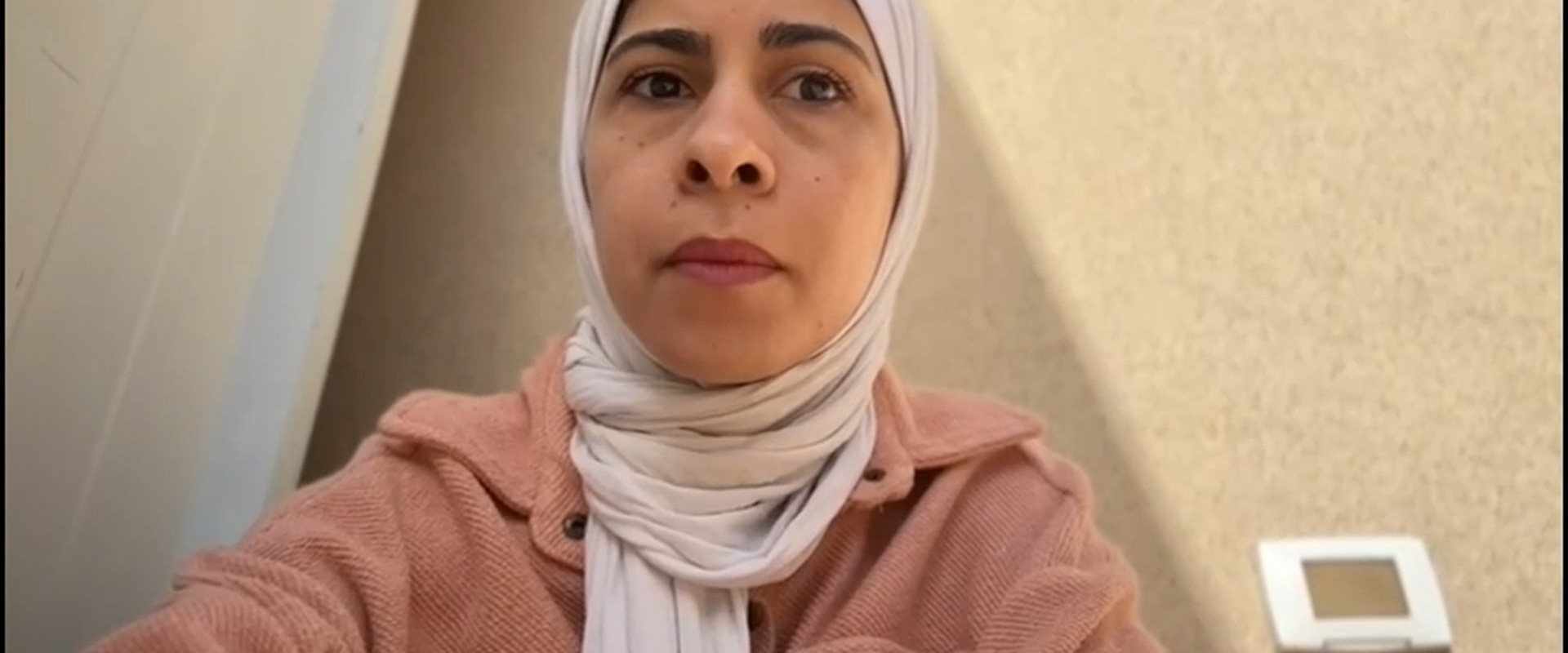
Shurouq*, 32, on how the everyday life looks like in Gaza. She is a Save the Children staff member and lost her husband after he was killed in the first weeks of the war. Along with her 4-year-old daughter, Karmel*, Shurouq has been displaced many times during the war. Here is what she and her daughter have experienced since Oct 2023.
17. September 2026
For me and other mothers who are in Gaza, the morning of the first day of school was unbearably heavy.
As a working mother with an income, I know how privileged I am to have been able to enroll my daughter in a private school in Gaza. My four-year-old daughter started kindergarten this year, and I wanted this to be a beautiful and promising beginning for her.
The term "private school" sounds rather fancy. Indeed, the $200 monthly tuition is a fortune in Gaza right now. Yet, it is the closest school to my home. With transportation unavailable, I would not risk having my daughter walk long distances through the rubble to get to school.
Her first day at school was overwhelming, no matter how much I was ready for it. My daughter looked at me and suddenly asked “Can my dad see me from heaven while I’m wearing my schoolbag?” I held back my tears and told her, “He must be so happy. This is a big achievement. Let’s dedicate it to him.”
I could see the pain in her eyes, and I wonder if she could see the pain in mine too. She was surrounded by children whose mothers and fathers had come to be with them, while her father was nowhere to be seen.
It was not only me who was trying to withhold tears. Many people were crying, with some hiding their faces from their children so they wouldn’t see the emotion.
I tried to hold myself together and gather my emotions, and entered the class with my daughter, but her teacher asked me gently to leave.
I left the class and I walked out of the school crying in the street. I cried for my daughter. I cried for the more than 21,000 children killed in this war who will never know what it means to have a first day back at school. I cried for more than 59,000 children who have lost one or both of their parents.
I cried for the thousands of children who cannot return to school because, in Gaza, education has become a luxury that many families can no longer afford. I cried for an education that is no longer a right for every child.
But despite everything, seeing how happy my daughter was to make new friends at school brought a little comfort to my heart. She found a friendly, colourful place where she could feel welcome, connect with others, and simply be a child for a while.
11. August 2026
Another sleepless summer night, in the shelter room I share with my three-and-a-half-year-old daughter. She woke up yesterday at 2am and whispered in a suffocating voice, “Mum, why does it feel like I can’t breathe? There’s something here,” pointing to her chest.
Night is supposed to bring relief, but here the heat does not leave when the sun goes down. I was helpless. I splashed water on her face. Every window in our shelter was already open, as though the threat of mosquitoes, insects, and rodents had become less frightening than the suffocating heat. I grabbed a plastic serving tray and fanned her, hoping to ease her breathing.
9. April 2026
Six months after the ceasefire agreement came into effect, we are still living in a grey city. Grey dominates everything, from the buildings to the streets to the dust on our faces. It even dominates our mood and futures.
You cannot move on or begin to heal while living in the same place where you experienced your worst nightmares – a place that hasn’t changed in months despite the bombs not falling as intensely, and agreements on a fast reconstruction. Every day on my way to work, I pass by my destroyed home.
Our home was a large rooftop apartment and each time I look at the building and see it destroyed I remember how much time and money my husband and I spent designing a modern home for a newly married couple.
What breaks me the most is my daughter’s room. It was brand new and filled with pink, yellow, and purple toys and decorations. We designed it thinking that the room would grow with her through all the different stages of her life, but my daughter never spent a single night in that room.
How do I explain to a small child, who lost her father at 11 months old, that she once had a father, a home and her own bedroom painted bright pink, yellow and purple?
Six months into the ceasefire I don’t feel at home, even though I am in my homeland. I feel like a stranger who is displaced and with relatives. My daughter and I have lost our privacy.
We feel like we are living half in war and half in peace because nothing is happening on the ground to show us that there is away to a brighter future. We are still hearing bombs.
A few days ago, I managed to buy a refrigerator, but I still don’t have a source of electricity. My daughter, who has lived through war most of her young life, thought it was a closet!
I also managed to fulfil her dream of owning a doll. No toys that I know of have entered Gaza since the ceasefire was announced, and searching for a toy was exhausting.
I often try to force myself to move forward and stop comparing life before the war to life after it, but I cannot.
2. Februar 2026
According to the news of reopening of Rafah border crossing, only 50 patients and injured are allowed to leave Gaza with only two companions. I've just received a call from a mother of a 12 year old injured child, a boy.
And she was, like, complaining, and crying at the same time. Like, “Shurouq, if I have to travel with my injured child along with my husband, for whom I’m gonna leave my four children in a makeshift tent in such harsh circumstances?!” And this actually left me speechless
18. November 2025
On Friday, people woke up and found themselves submerged in sewage water. We’ve had two years of living in tents, and they are already worn out; they cannot withstand the wind, or the rain.
“I saw a woman with a six-month old baby, carrying her running around screaming “Where shall I go?”
13. September 2025
After surviving 21 months of relentless borbardments in Gaza City with my 3-year-old daughter, I made the heartbreaking decision to flee to the south.
I left behind everything: the grave of my husband, the rubble of our home, ans the city where I grew up, laughed, loved, and lived the best moments of my life.
Displacement is just a word for many. But here, it's a full -body experience. It's not a suitcase and a new start. It's fire. It's fear. It's fleeing with nothing but the barest essentials, if you're ucky to even have those. The simplest things, like my daughter's summer clothes, become irreplacable treasures. Markets are empty. Borders are closed. And what little is available is often out of reach, too scarce, too expensive, ot too far away.