SAFE SPACES: Strengthening Schools to Protect Children with Disabilities from Violence
Goal: Protecting children with disabilities from violence – both in and outside of school
Project duration: May 2025 – April 2027
Project partner: Child Protection Association Hamburg (Fachstelle Schutzkonzepte, Kinderschutzbund Landesverband Hamburg e. V.)
Project location: Hamburg
Background
In Germany, one in three children experiences different forms of violence. Children with disabilities are twice as likely to experience VAC (violence against children) than children without a disability.
Violence does not only occur within family contexts – it can also take place in schools. Yet, schools in particular are supposed to be safe spaces that offer protection and security where children learn, thrive, and reach their full potential without fear.
Schools bear dual responsibility when it comes to child protection: on the one hand, they must protect children from violence within the institution. On the other hand, they are obliged to cooperate with the relevant child and youth protection services if there are signs of potential violence against children.
Project Idea
The project "SAFE SPACES: Strengthening Schools to Protect Children with Disabilities from Violence" started in 2025 following the project "As Soon As Possible! Activating Schools for All-Encompassing Child Protection".
SAFE SPACES builds on the experience of the previous project and continues our work on building schools’ capacity in the area of child protection. Together with the Child Protection Association Hamburg (Fachstelle Schutzkonzepte, Kinderschutzbund Landesverband Hamburg e. V.), Save the Children is now focusing on protecting children and adolescents with disabilities. The aim of the project is to strengthen schools’ role in the child protection system and to support them in becoming safe places for all children.
Key focus of the project is raising awareness of child protection among school staff. Teachers as well as other educational staff will receive targeted training to improve their professional skills. Equally important is the active involvement of the students themselves, because child protection can only be effective if children and adolescents are involved in the development of protection policies. In child participation workshops, they will be encouraged to talk about their experiences and share their perspectives and concerns regarding child protection.
Implementation
The project targets specialized schools for children with disabilities (so-called "special schools") and inclusive schools in Hamburg. Target groups include:
- School administrators, teachers, and staff working directly with children and adolescents with disabilities (e. g., school social workers, psychologists)
- Students with disabilities
- Civil society organizations engaged in the field of child protection in schools
The project includes five components:

Component 1: online training series
The training series comprises nine modules. All training sessions are led by two experienced trainers and combine technical input with interactive methods for individual and group work.
The nine modules are structured as follows:
Modules 1-2
Modules 3-8
Specialized information for school staff developing child protection policies.
Module 3: Needs assessment
Module 4: Boundaries in educational relationships
Module 5: Child participation as a core element in the development of child protection policies
Module 6: Developing concepts for sex education for children with disabilities
Module 7: Complaint and reporting mechanisms
Module 8: Procedures in suspected cases of violence

Component 2: mentoring for developing protection policies
Two schools receive intensive, individually tailored mentoring and supervision to develop their own child protection policies – practical, sustainable, and adapted to each school’s context. This process enables each school to develop a customized protection policy – based on professional knowledge, joint reflection, and concrete implementation steps – to ensure greater safety and participation of children in everyday school life.

Component 3: child participation
A child protection policy for schools can only be effective if children and adolescents themselves are actively involved in the development. The project therefore places particular emphasis on the participation of children – especially children with disabilities. Their perspectives, experiences and requirements are central to the development of effective policies that make school a safe, inclusive, and collaborative place for everyone. With this in mind, child-friendly participation formats will be developed and implemented in the schools participating in mentoring.
To strengthen sustainability, the project partners will be developing a toolkit that contains tried-and-tested methods for child participation for educational school staff working with children with disabilities.

Component 4: educational materials
To empower stakeholders beyond training, supervision and mentoring, the project will develop accessible materials for everyday school use.
Planned resources include:
- Awareness-raising materials for the school community on protection from violence against children and information about support services
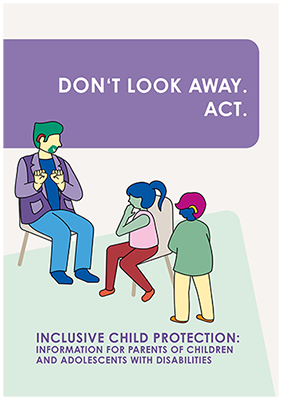
- Child-friendly materials for children with disabilities about their rights – especially the right to protection from violence
These resources offer practical guidance for school staff, parents, and children in Hamburg – contributing to a safe, inclusive school environment.

Component 5: networking and exchange
Key project outputs, such as training materials, mentoring guidelines, the toolkit for child participation, and other educational resources will be shared in live online seminars.
These seminars provide space for professional exchange, discussions, and networking. Together with the participants, experiences will be shared, challenges are reflected upon, and questions about practical implementation are explored – with the goal of strengthening child protection structures in schools, long term.
By actively involving civil society organizations, the dissemination and practical use of the developed materials are deliberately supported. This approach enables schools to be supported beyond the scope of the project and helps strengthen inclusive child protection concepts across Europe
Materials
Support services
In addition to the materials, the Padlets listed below provide a selection of counselling and support services on child protection topics for professionals, parents, and for children and adolescents.
For parents and professionals


For children and teenagers

Partners
This project brings together the expertise of Save the Children and the Child Protection Association Hamburg (KSB).
Founded in 1953, KSB is a registered non-profit organization committed to improving the lives of children, youth, parents, and families.